Academic Work
Reach For The Stars


One of the first major projects I put out was my final project for the IGME 235 Intro To Web Technology class at the Rochester Institute of Technology was 'Reach for the Stars'. A simple modification of the 'Circle Blast' game programmed as an earlier exercise, this simple Javascript game provides a rudamentary space shooter with fifteen levels, sound effects, and a few additional ways to change how to play it, it's not one of my proudest projects, but it was one of my first experiences with an interactive coding project.
Link to 'Reach for the Stars'- NOT desgined for mobile
Phyllotaxis / Algorithm Botany

As part of the IGME 330 Rich Media Web App Development Class, we were instructed to use the Canvas API to create a phyllotaxis spiral using an algorithm in Javascript. The above picture is the result of one of the generated patterns. The instructions were to generate this algorithm to work with buttons that would pause / resume and restart the pattern and a seperate button to export the current state of the canvas to an image file. We were told to be creative with the projects, so I provided five different options for colors that generate in different ways.
Audio Visualizer


One other project for the IGME 330 class as mentioned above was to create an audio visualizer assignment that read music using Javascript and convert that music into data that would update on a Canvas. The style of the visualizer was up to us to decide, so I provided three different options in a record player, a disco party, and a seismograph as seen in the provided images. I also applied other functions to the tool from previous audio visualizer assignments such as generating noise and being able toggle the color, disable certain aspects of the visualizer, alter the color scheme, and impact the base and treble of the music.
Level Design Builds
As part of the IGME 420 Level Design class, three major projects were to apply the concepts we've learned throughout the semester and create levels in various genres using those concepts. The games provided were 2D platformer Battleblock Theater, puzzle-platformer Portal 2, and a first person shooter of our choice, my choice being Quake. The very last project was to choose our favorite level we made and provide audio commentary and what we enjoyed while making it and what we would do to improve the level in the future.
Battleblock Theater - Harrowing Haywire Havoc
The major aspects we were tasked with applying for the Battleblock Theater level were to get a general feel for the present mechanics of the game and then apply them with principles of level flow. The main aspect of the levels are to collect 3 of the 7 gems to unlock the exit, with optional goals of finding a hidden yarnball and finishing in a time limit. I wanted to change up the formula for the level by giving the player three different directions to the gems with unique aspects of Battleblock's design philosophy. The left leads to tight platforming, the right to enemy combat, and the top with being an instance of precision platforming with other obstacles. The level was created from a basic sketch, then to a playable prototype, and then critiqued with peers from the class for the final version playable on the Steam Workshop right now. The provided video demonstrates the finished version as well as a playthrough of the original.
Portal 2 - Take Me With You
The level designed for Portal 2 was meant to exemplify it's puzzle aspects and the natural flow of the mechanics as it was introduced to the player. We were to take an element from the game and then design a level chamber around that mechanic in a three step process; introduce the mechanics to the player at the start with a simple task, reinforce the task by providing an expansion to the first puzzle, and then apply a twist to the mechanic that makes use of it in a different way. The mechanic I chose was the Redirection Cube that points laser beams in different direction and activates mechanisms. The original version was to be three seperate levels that cater to each of the steps with a theme of bringing the redirection cube with you and making use of it throughout, hence the 'Take Me With You' name which would be followed by 'Take Me Too' which would use a second cube, and 'Take Me Back' which would end with the player losing the cube. I would've loved to expand the level into this idea, but I eventually combined certain elements to make one chamber for both simplicity and time.
Quake - The Temple of Zoom
The last level to create was for a first person shooter of our choice, of which I would have chosen the original Doom if it met the proper requirments, so I settled with Quake instead. We needed to design the level using tools that would make it a viable level from both a gameplay standpoint as well as a visual standpoint. Environmental storytelling was the aspect we needed to make use of, so I designed the original level as starting within a temple and fighting your way out towards an enemy encampment. This level was easily the most difficult to create as I worked with Trenchbroom, an external level designing tool as opposed to the internal tools of the previous two projects. It was diffcult to understand how Trenchbroom worked with it's own components and make the level feel authentic while keeping the original vision intact. Though it was a challenge to make, I feel as though it was a solid attempt at capturing the idea and making good use of mechanics like hidden walls to keep the experience interesting.
No Playable Version
Favorite Project / Audio Commentary
The very last assignment for the class was an audio commentary on the level I enjoyed creating the most and aspects about the course that I enjoyed. The provided video goes into detail about my choice of Portal 2 being my favorite with some extra notes to explain my design decisions I didn't go into detail on with the original video. The game footage was captured by me and edited via the video editing tab of Blender, as well as subtitles typed by myself.
'Don't Push Your Luck' Interactive Story
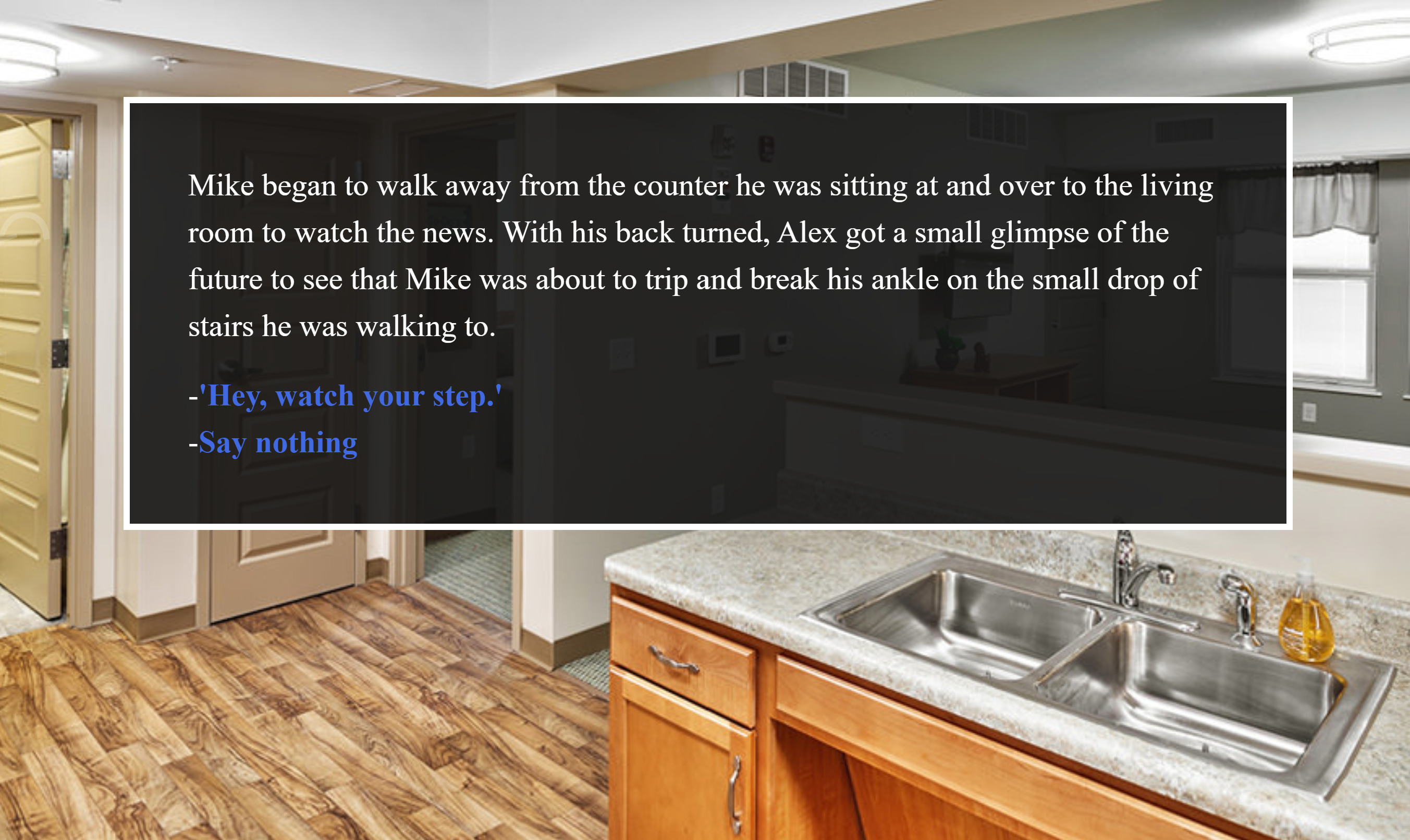
The culmination of my work for the IGME 529 Foundation of Interactive Narrative class is in the story 'Don't Push Your Luck'. The requirments combined several storytelling techniques learned throughout the semester added to a story that would be told through three acts that would express character development and reactions. My story is about two roommates who can see the future and read minds respectively who attempt to keep their secrets from each other when betting goes too far. While rudamentary in interactive elements, I'm still happy with the way that this project turned out, especially with handling Twine to create all the transitions and sound effects.